
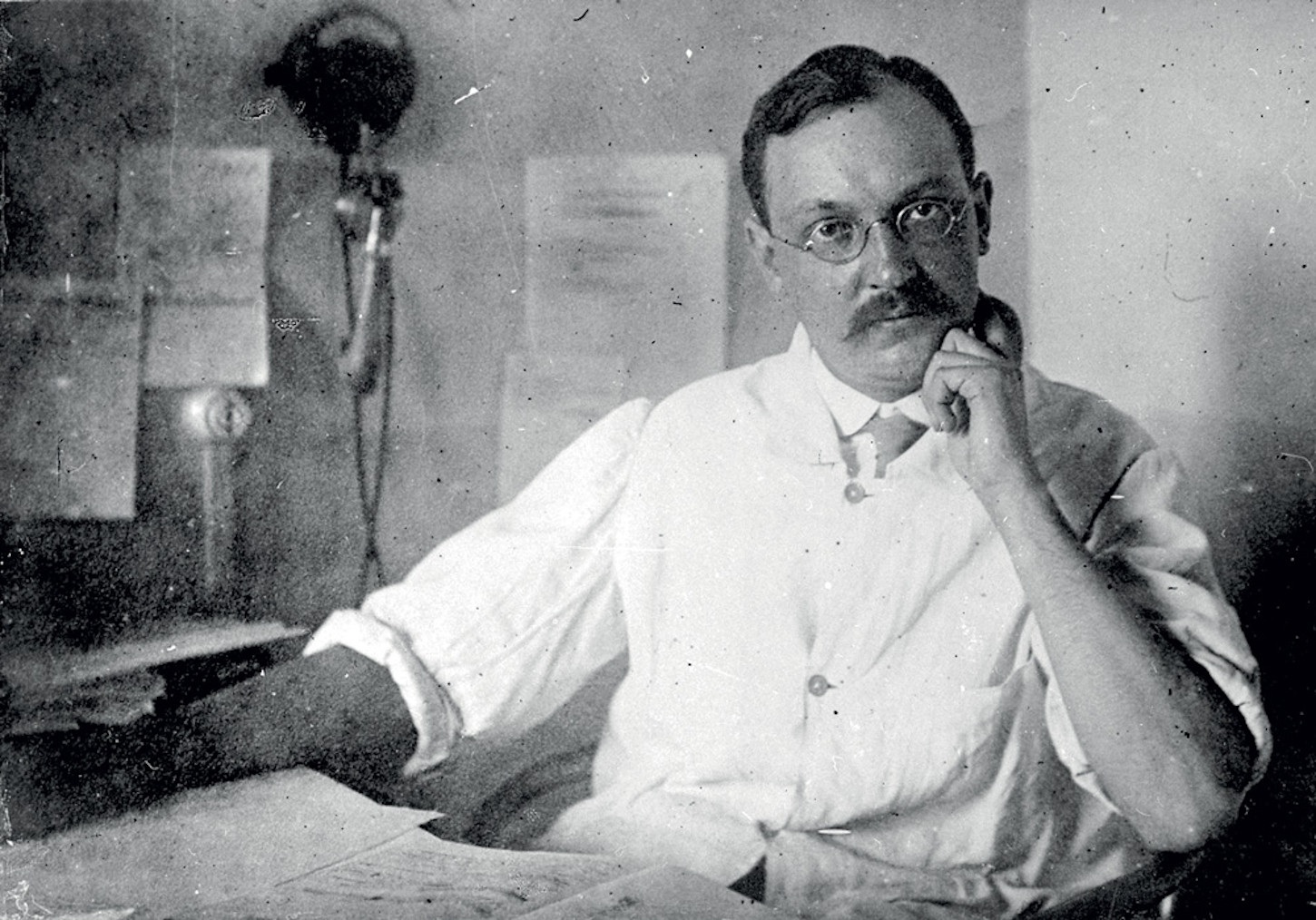
Born in Paris in 1884, Georges Duhamel was a successful doctor and writer whose life and work were inseparable from the war and its horrors. A committed volunteer in 1914, he witnessed the suffering of French soldiers at first hand, working as a surgeon on the front line. Drawing on his wartime experiences, he wrote his novel Civilization, a deeply pacifist work that was awarded the Prix Goncourt, a prestigious literary award, in 1918.
Admitted to the Académie française in 1935, Georges Duhamel was then once again swept up in the mayhem of a new world war and, like thousands of Parisians, found himself fleeing the capital in mid-May 1940, shortly before it was declared an “open city” and the arrival of the Germans. Together with his wife, Blanche Albane, he travelled to Rennes, where one of their children, Jean, was studying medicine. It was there that the writer also met the renowned surgeon Eugène Marquis.
In Ille-et-Vilaine, Doctor Georges Duhamel quickly returned to his medical duties, this time at Pontchaillou Hospital, which he described as “the kingdom and sanctuary of charity in peril.” He operated on around five patients a day, as the number of defeats increased for the French army. In Lieu d’asile, a text banned by the Germans that recounts his experiences in Rennes, the Prix Goncourt winner states that he treated 600 people.
Translated by Tilly O'Neill
