
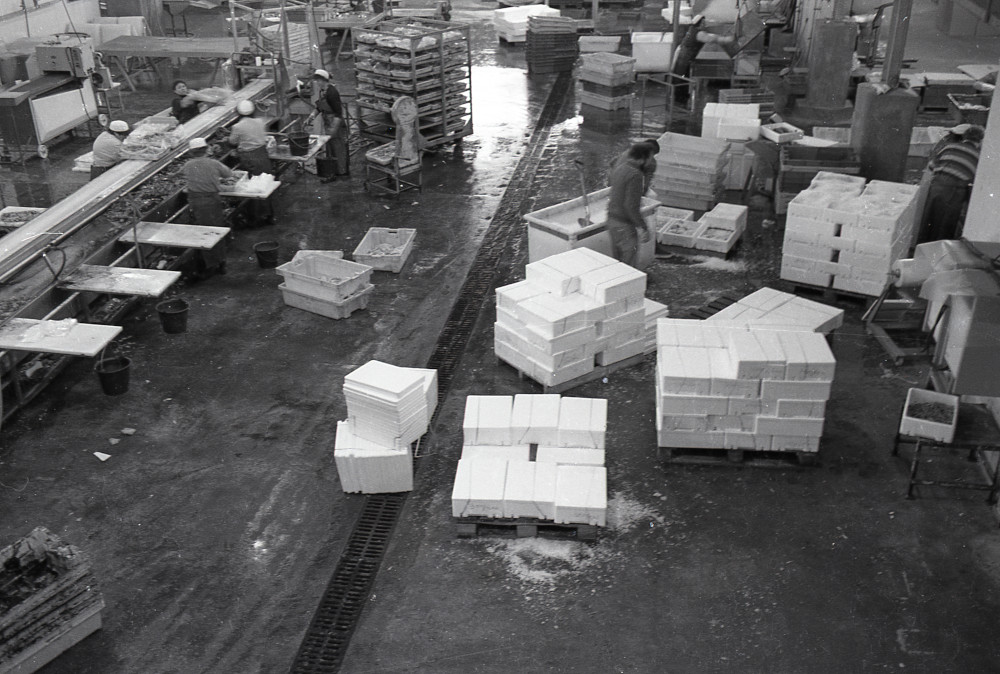
The port was divided into two sections: one where the trawlers landed their catch, and a longer, separate basin for the pinasses. "Sorting the catch from the trawlers and sorting the catch from the pinasses were two completely different jobs. The trawlers brought in the big fish, while the pinasses landed smaller fish of all different sizes and shapes. You had to work quickly," explains Jeanne Le Clouérec, who worked as a sorter on the pinasse quay.
Two separate landing areas with two very separate teams.
- The industrial fishing fleet landed its catches in the trawler basin. Lorient was home to the country's most modern fleet of stern trawlers, owned by the ship-owners Jégo-Quéré. The ship-owners also founded Lorient's unloading company, Sodelor, which leased the port equipment and recruited and paid the dockworkers and sorters on a flat-rate basis.
- The local pinasses landed their catches in a separate basin. The professional ship-owners' association of Lorient and Étel issued each night-shift sorter with a badge confirming that she had been hired. The group paid the unloaders and sorters by the hour. Until 1973, the sorting teams were overseen by female supervisors who used methods that were considered both unorthodox and abusive.
There were also differences in working conditions, which were more comfortable and better adapted on the trawler quay, where more efficient equipment, such as conveyor belts, was used. Differences also existed in trade union affiliation: the CFDT was dominant among Sodelor’s sorters, while the CGT prevailed among those working on the pinasses.
On the quay dedicated to the smaller pinasses, the women sorted high-value fish species such as hake, skate, monkfish, langoustine, pollack, black seabream, megrim sole, red seabream, longfin tuna and red gurnard.
On the industrial fishing quay, the catch consisted mainly of more common species: pollock (27.5%), whiting, cod, blue ling, haddock, common ling, spurdog, mackerel and squid. In 1972, high-value species accounted for 24.82% of the catch, while common species represented 58.5% among the stern trawlers.
Translated by Tilly O'Neill
