
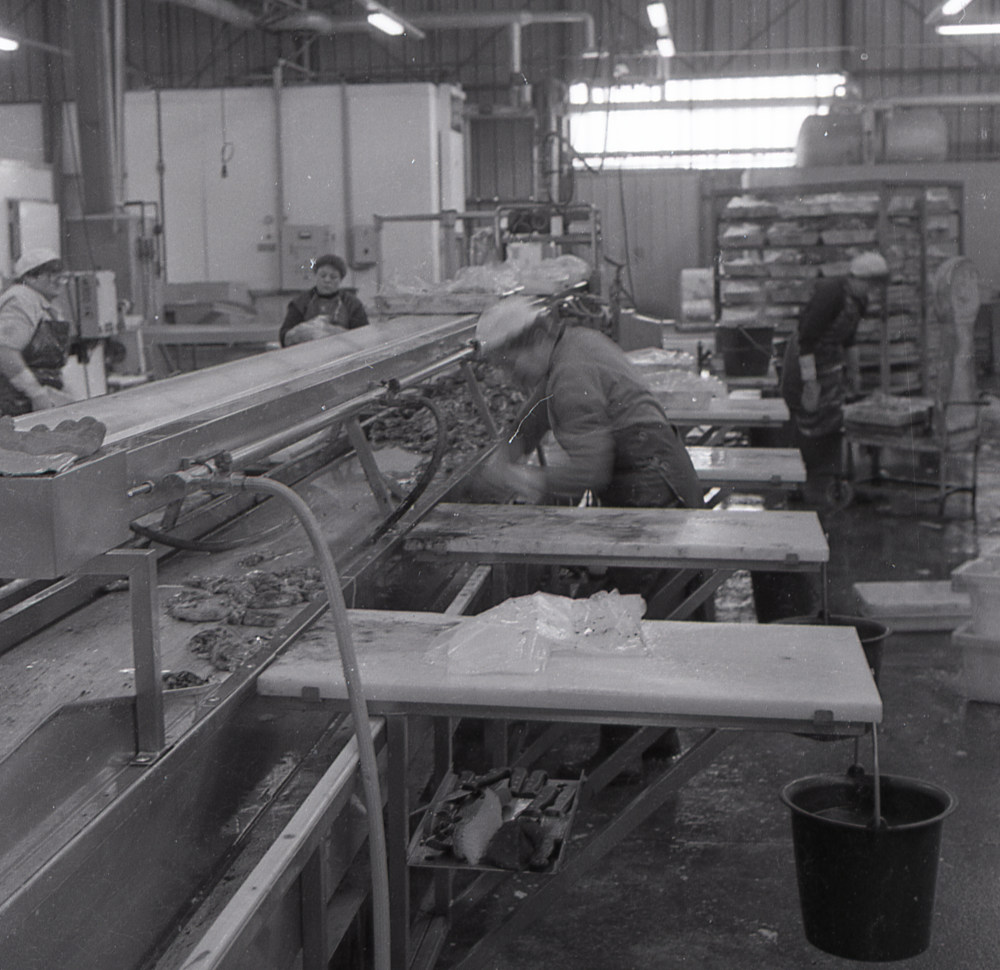
Close to 1,000 women worked at the fishing port between 1965 and 1985. They were "local girls", from the coast and from villages on the other side of the harbour, including Locmiquélic, Riantec, Plouhinec, Sainte-Hélène, Merlevenez, as well as Plœmeur and Guidel. Within this port community, they were considered distinct from the "city girls" who lived in Lorient or Lanester. In the 1970s, the geographical origins of these female workers broadened to include other towns and villages in the Lorient area, such as Gestel, Quéven and Guilligomarc’h, as well as much farther afield, with the arrival of refugees from Vietnam and Cambodia. They travelled to work on foot, by bicycle or by moped. Those coming from the far side of the harbour (the rive gauche) took the Vedette passenger ferry across the water, which they nicknamed the Sabot (clog) because of the amount of water it took on. Some of these women would later obtain a driving licence. A car represented social mobility, access to modernity and a new sense of freedom.
These women were just as likely to come from maritime families as from local farming families. Many came from modest backgrounds, often poor, with some living below the poverty line. Two or even three generations worked side by side. Many of the older women, who had begun their working lives as seasonal workers in the region's fish canning industry, had obtained school-leaving certificates in the 1950s. The next generation often left school, sometimes as early as the age of 16, without a diploma and went straight into work. Since their mothers were already employed at the port, this naturally opened doors for their daughters to join them working for wholesalers, in a factory, or at the sorting benches or filleting tables.
The work required no formal qualifications, and the part-time night shift was well paid. The shift was popular amongst female workers because it offered a practical solution to both economic and family responsibilities. It was the ideal arrangement for those with domestic and childcare duties. It provided an additional income while allowing them to look after their children after school at a time when household chores and childcare were rarely shared between partners and childcare provision was virtually non-existent.
"I wouldn't have been able to work if there hadn't been a night shift. I had no one to look after the children, and my husband was at sea. It made everything easier."
Translated by Tilly O'Neill
