
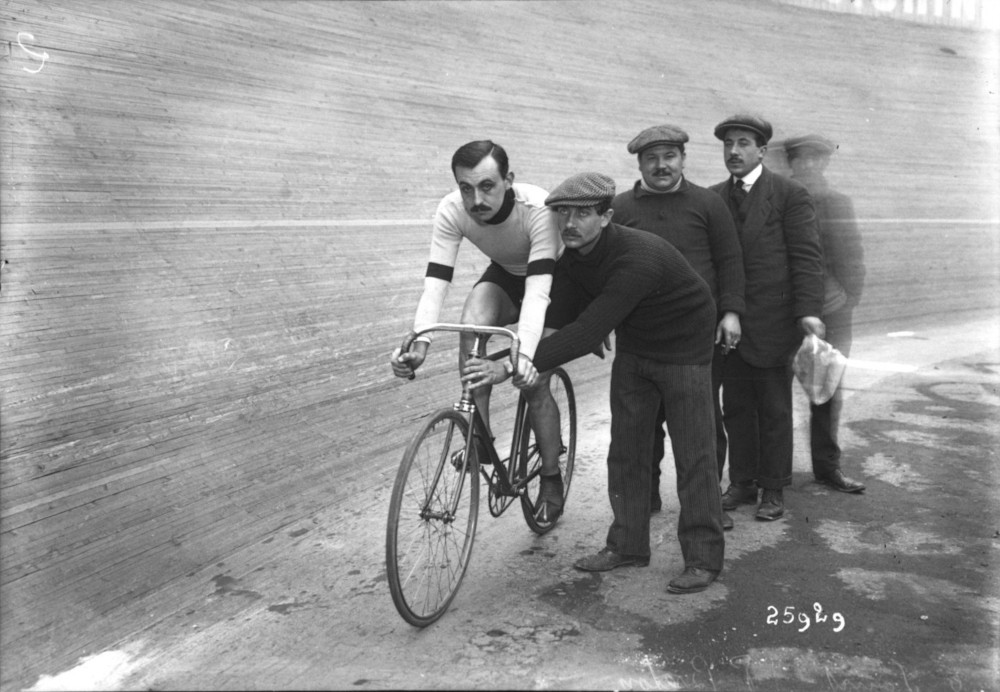
Sometimes referred to as the ‘as de la pédale’ or the ‘pedalling aces’ (as opposed to flying aces), the people of Brittany have a reputation as bicycle kings. It’s said the first bicycle was even developed by a Breton from Saint-Brieuc, Ernest Michaux, who owned a coach-building and locksmith atelier in Paris. He and his father decided to fix pedals to a wooden dandy horse, or draisienne, the bicycle’s ancestor. A promising start. But it was probably the success of the first Paris-Brest-Paris bicycle race in 1891 that turned Brittany cycling mad. The majority of the region’s municipalities decided to found their own race. Some religious traditions even lent themselves well to the organisation of sporting events. The famous Tour de France, first created in 1903, also sparked huge enthusiasm. Lucien Petit-Breton from Plessé (44) was the first cyclist to win the Tour de France twice. Jean Robic, Louison Bobet, and Bernard Hinault would all follow in his footsteps. And cyclist Nathalie Even-Lancien became Olympic champion in 1996. Today, the huge and enthusiastic levels of support reserved for Audrey Cordon-Ragot, Warren Barguill and David Gaudu show that the region’s love for all things cycling is as strong as ever.
From Rugby to Football
But Bretons are also ardent football fans, with supporter passion and enthusiasm reaching fever pitch during derbies and French Cup matches. Everyone remembers the 2009 headline of football magazine L’Equipe, renamed Ar skipailh in Breton, which celebrated the final goal of the French Cup between two Breton teams, Stade Rennais and En Avant de Guingamp. And yet, there is no reason to assume Brittany was predestined to be a land of football lovers. The sport was introduced in France at the end of the 19th century, but didn’t take off on the Breton peninsular until after the Great War. Until then, rugby was the more popular sport. In 1913 sports newspaper L’Auto presented the Brest rugby season with great enthusiasm: "Judging by the size of the crowd that comes to watch the training sessions […] this sport is about to become the region’s most popular!" At the start of the 20th century, rugby was gaining in popularity, especially in Nantes where the number of teams was increasing rapidly. The enthusiastic articles written by sports journalists kept supporters on tenterhooks as the matches played out. Today the Vannes Rugby Club has taken up the torch, giving teams from the south-west of France a run for their money.
Traditional Sports
It used to be that the aim of these games was to showcase players’ physical force, dexterity, precision and team spirit. One immediately thinks of gouren of course, a form of wrestling practised in the Middle Ages and revived in the 1950s, but the tradition of "pole holding", or bazh-yod, in which one player holds up a heavy pole from a sitting position while their opponent tries to knock it from their grip is also alive and well, as is ar Maen pouez, the well-known weight throwing sport, which has been recorded since the 17th century in Plogonnec in south Finistère. Men compete to lift huge stones weighing between 80 and 90 kilos! Might the people of Brittany convince the Olympic Committee to include gouren, or even better, the popular Breton palet game as an Olympic sport? They're certainly capable of it...
Translation: Tilly O'Neill