
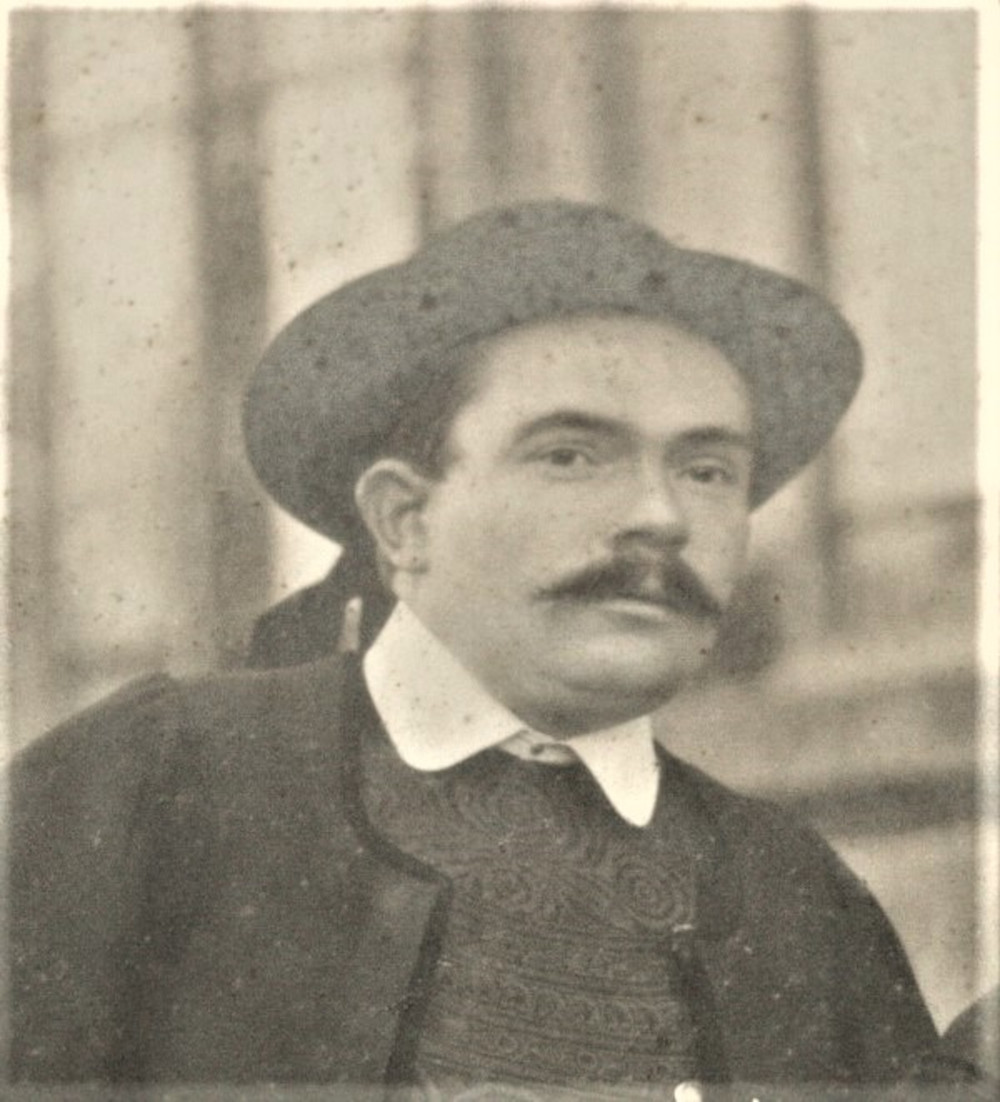
When Corentin Pichavant attended the 1900 Universal Exposition, he had no idea that his voice as a young man would still be heard more than 85 years after his death. The fifth of seven children, he travelled to the exposition with his older brother, Auguste Pierre Marie, to represent the family's thriving embroidery business. Founded in 1868, the business had grown rapidly and employed 65 male and female embroiderers by 1899. At the turn of the twentieth century, Maison Pichavant was at the height of its reputation and craftsmanship, and was the largest embroidery business in Pont-l'Abbé.
During this period, the Pichavant family played an active role in the emerging regionalist movement. Their embroidery business was represented at major gatherings of the l’Union régionaliste bretonne, and their work was promoted by figures including Charles Le Goffic, Théodore Botrel and François Jaffrennou. It was therefore no surprise that the Pichavant embroidery house should set up a boutique at the Breton Village within the Universal Exposition, which showcased the region, its traditions, art, customs and costumes.
Contemporary accounts of the Breton Village frequently mention the Pichavant brothers, not only for their skill as embroiderers but also for the time they spent dining in the thatched cottage that could also be found in the Breton Village. Their younger sister, Corentine Marie Pichavant, known by the nickname Mavinig, was also present at the exposition. According to the writer Pierre-Jakez Hélias, one could spot her strolling down the Champs-Élysées on the arm of the Count of Najac, Mayor of Pont-l’Abbé.
On 24th July, under the direction of Léon Azoulay, Corentin Pichavant made two recordings. The Parable of the Prodigal Son, is a unique example of this biblical text in Bigouden Breton. The second, in an altogether different register, is the lighthearted tale of Yann al Leue, or 'Simpleton'. It’s an extremely rare example of a repertoire that barely features in Azoulay’s catalogue and which was almost completely overlooked by other collectors of oral documentation at the time.
Corentin Pichavant married 18-year-old Jeanne Boennec in Loctudy on 25th November 1907. A few years later he was called up and left to join the Front on 4th August 1914, returning in February 1919. His military records show that he knew how to read, write and count, that he was 5ft 4, had chestnut hair and a round face. Corentin Pichavant died on 1st April 1938, just before the Second World War broke out.
The Pichavant embroidery house was taken over by Auguste Le Berre, the Maison Pichavant’s founder’s grandson, from 1932 until its closure in 1965.
"Traditional Folktale about Love", told par Corentin Pichavant.
The current transcript was produced by Yann Guillamot. [Certain words are in italics. The transcriber has tried to find a compromise between the piece’s orality and the official standardised version of Breton spelling]
Breton, Pont-l’Abbé dialect from the Bigoudène region.
"L’amour", an old folktale.
Corentin Pichavant:
Doare petore e vez kaset ar briedelezh d’un den yaouank.
Gwechall e-barzh e Pornaleg e oa un den hag en doa ur mab. Ar mab-se e oa dizesperet o welet
anezhañ lar ne zimeze ket. Petra en doa graet dezhañ neuze ?
Eñ en doa ur vatezh a oa hec’h anv Ar Vadelezh, Marjann.
- Setu Marjann baourez ! Met petra bennak a rafez ivez evit lakaat ar paotr Yann aze e-giz-se
da zimeziñ ?
- Gortoz, gortoz, gortoz ! Me a zo o vont bremaik-tuchant da zegas dezhañ c’hoant
dimeziñ !
Hag hi da vont ivez da Bont’n-Abad, aze e-giz-se e oa ur patiser e-barzh ar ru vras, ha kas ganti
ur panerad gwastell. Ha mont goude-se neuze, pa oa aet Yann da gousket, da e wele gantañ.
-Yann…
-Petra a zo Marjannig ?
- Dal ! Bez’az to priedelezh ?
Hag hi hag ober ur wastellenn dezhañ neuze…
-Che… a lâr-eñ, ar briedelezh a zo mat ! Groez din un all c’hoazh !
-Un all c’hoazh ?
-Eya !
A-barzh fin he doa groet un dousenn dezhañ. Un dousenn gwastilli. Setu e-giz e dad a oa neuze
e-barzh ar gwele all e-kichen ivez, hag a lâre dezhañ :
-Ale, paotr Yann, pign !
Hag eñ ha pignal neuze war-c’horre ur sol. Ha dindan ar sol-se neuze e oa un nev a oa dour en
enni. Hag e dad ha laret dezhañ neuze :
-Diskenn, diskenn c’hoazh paotr Yann !
Hag eñ ha diskenn neuze :
-Tad, a lâr eñ, me a zo kouezhet e-touez an dour !
-Mat, mat emaout, mat emaout !
Ha setu e giz-se neuze. Hag eñ ha lâret da Marjann :
-Marjann ! A, Marjann ! Bez’ eo graet mat… ma peus trapet e briedelezh e vo mat neuze.
Hag en ur gouezhal e-barzh an dour en doa peget e-barzh en ur c’hazh hag ar c’hazh-se en doa
blev.
-Setu amañ ’ zo blev c’hoazh…
-Dres, dres, dres ! Mat emaout ! Mat emaout !
Article translated by Tilly O'Neill
